Make The Folded Part Fit Its Job
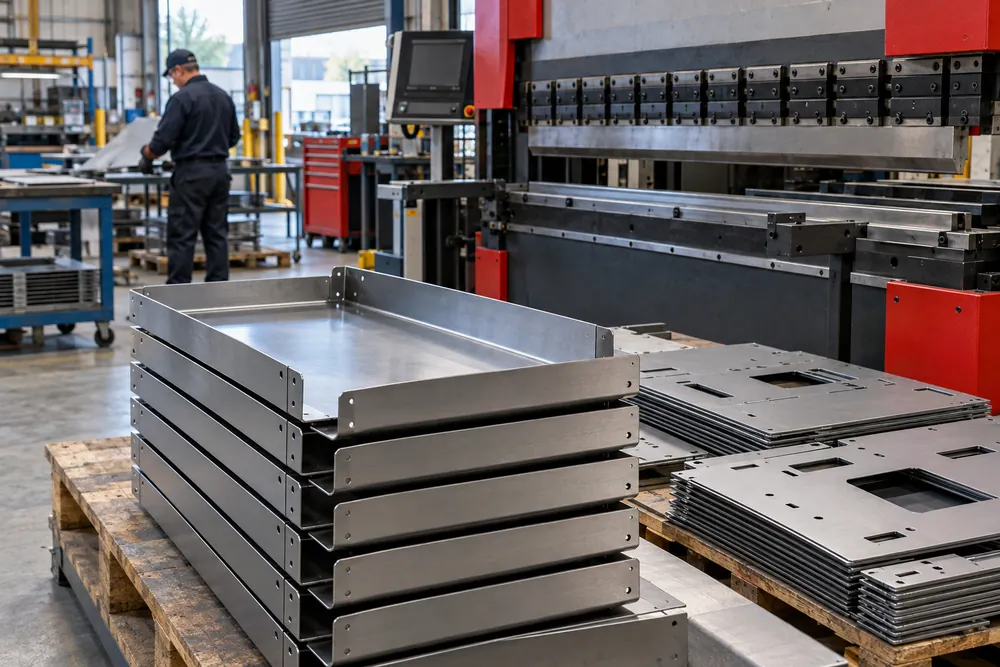
Sheet metal fabrication produces parts from relatively thin flat material through cutting, forming and joining. Commercial uses include equipment covers, folded trays, panels, brackets and enclosures. The finished geometry needs to work with the chosen thickness, bend radii and fixing arrangement, rather than simply matching the outside dimensions of a sketch.
We help Leicester businesses describe both the visible form and the practical requirements behind it. Tell us whether a panel is removable, exposed to weather, subject to regular cleaning or used beside moving machinery. These details influence material selection, edge treatment, drainage, fixings and the way several pieces should fit together.
Material Choice And Surface Requirements
Mild steel, stainless steel and aluminium have different strengths, corrosion behaviour and forming characteristics. A material should be selected for its working environment and the design requirement. Stainless steel still needs a suitable grade and finish, especially where cleaning chemicals, contamination or persistent moisture are involved.
If appearance matters, identify the face that will remain visible and the acceptable direction of any brushed finish. Protective film, handling marks and weld dressing should be discussed before production. An enclosure inside a plant room may need a practical protective coating, while an exposed architectural panel may have a more demanding visual brief.
Drawings, Development And First-Off Checks
Begin with a dimensioned drawing or a model, alongside the intended quantity and material. State whether dimensions describe the finished folded component or the flat blank. A flat pattern may need adjustment for the selected tooling, material and bend allowance before it can produce the intended finished part.
After the cutting profile is agreed, fold positions and the bending sequence need checking. Closely spaced holes, short flanges and enclosed shapes can limit tool access. Small geometry changes can sometimes simplify manufacture, but they must be approved rather than introduced without the buyer’s knowledge.
For a repeat batch, a first-off check helps establish that the part fits the real assembly before the remaining quantity is made. Identify the dimensions that are critical to function and the tolerances that genuinely matter. Applying an unnecessarily tight tolerance to every feature can add work without improving the final assembly.
Edges, Joints And Access
Cut edges should be specified with the handling and operating conditions in mind. A folded return, deburred edge or covered edge may be appropriate depending on how people interact with the item. Access panels also need enough clearance for removal and for the tools used to release their fixings.
Welded joints can distort thin material, so the joining method and visible finish should be considered together. Rivets, screws and other mechanical connections may suit some assemblies. If a tray must retain liquid or an enclosure must resist water ingress, describe the required performance and how acceptance will be checked.
Safety And Applicable Requirements
Sheet metal parts do not all fall under one certification requirement. A load-bearing construction component may come within BS EN 1090-1, while a simple cover may have a different route. The intended use decides which requirements apply, so buyers should avoid specifying structural conformity documentation for every item without considering its function.
For machinery guards, the machine risk assessment and the Provision and Use of Work Equipment Regulations 1998 are relevant to the overall arrangement. A fabricated guard must be assessed for access to danger, fixing and maintenance needs. Where fabrication includes welding, COSHH controls for fume remain relevant even when the assembly is small.
Pricing And Preparing Your Enquiry
Cost is influenced by material grade, thickness, sheet utilisation, cutting detail, number of bends, joining, finish and batch size. Prototype work and repeat production have different setup demands. A stable drawing and realistic tolerances make it easier to assess production methods and compare quotations on the same basis.
Include overall size, quantities, material preference and photographs of the installation space. List cut-outs, captive fixings, mounting points and any mating components supplied by others. For an existing Leicester production line, explain shutdown restrictions and whether a first-off fit check is needed before the complete order is released.
Approve A Repeatable Finished Part
For a production batch, agree how a completed part will be accepted. Identify the fixing centres, mating faces and visible surfaces that determine whether it works. A simple checking fixture or trial assembly may be more useful than measuring an arbitrary list of dimensions that do not influence fit.
Packaging also needs attention where parts have finished surfaces or thin unsupported edges. Describe stacking limits and any protective separation needed between components. Label variants clearly, especially when a left-hand and right-hand version look similar but have different hole positions or folds.